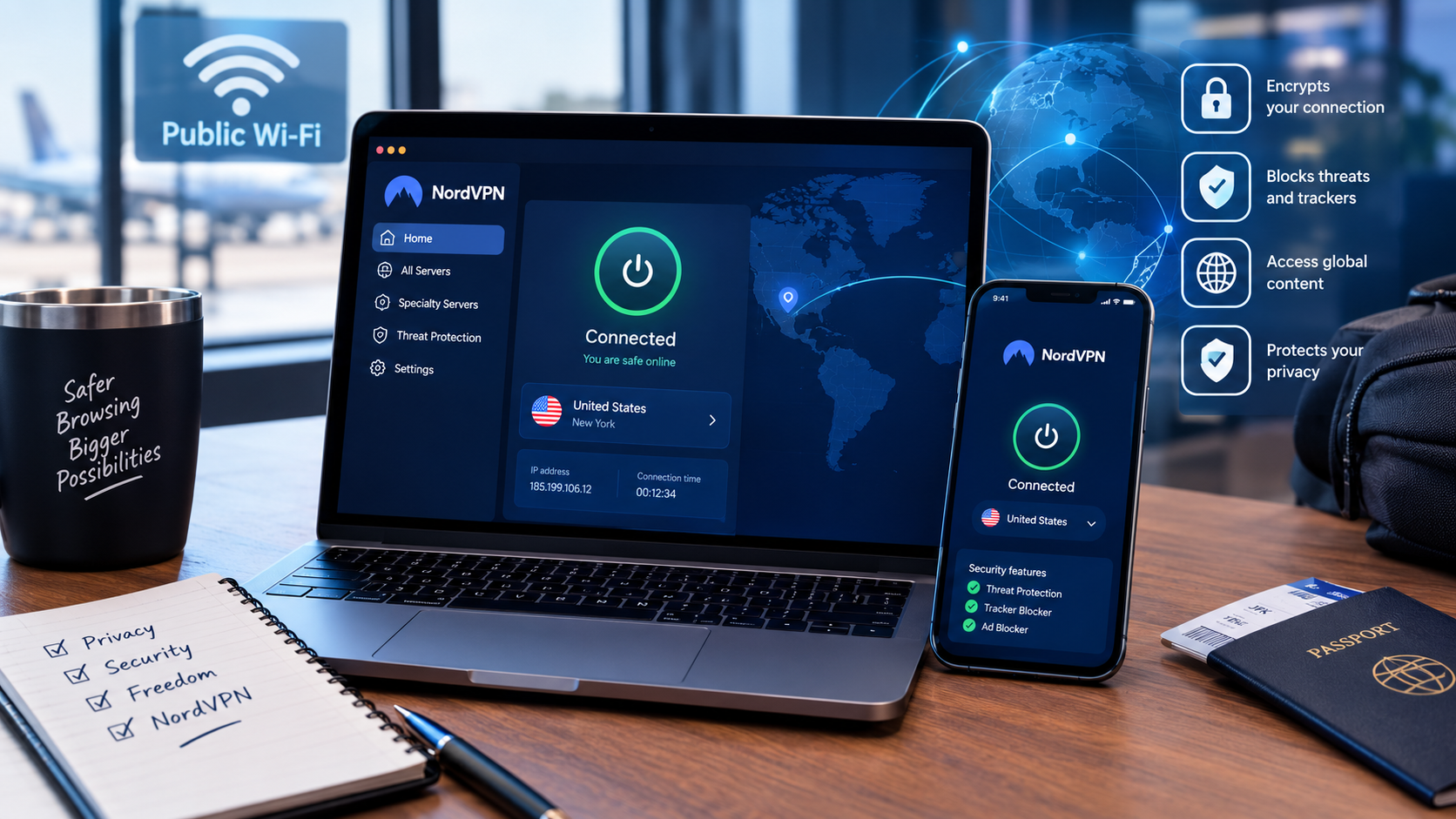
A VPN sounds like one of those things you only need if you are extremely concerned about online privacy.
Then you connect your phone to Wi-Fi at an airport, hotel, cafe or shopping centre and suddenly the idea makes a little more sense.
Your internet connection is carrying emails, passwords, searches, personal conversations and sometimes financial information. So the question is not whether a VPN can change your IP address. The better question is whether paying for one would give you meaningful protection and convenience.
That is what makes NordVPN worth examining.
NordVPN has become one of the most recognizable VPN services available, but popularity alone doesn’t make a product worth recommending. In this review, we are looking beyond the advertising to examine its security features, privacy claims, performance, pricing and the situations where it makes the most sense.
Disclosure: This article contains affiliate links. If you purchase NordVPN through our link, we may earn a commission at no additional cost to you.
NordVPN Review: What Does the Service Actually Do?
At its simplest, NordVPN creates an encrypted connection between your device and a VPN server. Your internet traffic is routed through that connection, while websites generally see the VPN server’s IP address instead of your normal public IP address.
That can be useful when you are connected to a network you don’t trust.
But there is an important distinction here: a VPN is not an invisibility cloak.
It does not stop you from being tracked by every website, eliminate phishing risks or make careless password habits safe. Think of it as one layer in a broader online-security setup.
NordVPN has also grown beyond basic VPN functionality, adding tools for malware, phishing, scam and tracker protection, alongside features such as Dark Web Monitor and Double VPN.
For readers considering the service, you can check NordVPN’s current plans and features before making a decision.